
New year, new brand? 5 signs it’s time for a rebrand.

The New Year is a great time to step back and reevaluate all you accomplished the year prior and make goals for the coming year. Performance goals for the year are a great way to stay accountable and keep business going – but when was the last time you looked at your branding?

Your brand is not only your name, but your first impression. It identifies and sets you apart from the competition. The perception your company gives off should be strong and positive, from your logo to your mission statement and throughout all marketing communications. A fresh, consistent style that represents the brand’s unique character will help to attract customers and build trust. Think about it: if you had to choose between two vendors, would you go with the one whose website is stuck in the past, or the one with a more contemporary look and feel? Even if the first company outperforms the latter, the lack of update will make anyone think twice. Updated and consistent branding increases how professional your business appears.

“The real power of a good brand identity is when it speaks to your brand’s personality, mission, and value in your market, making your business more memorable in the minds of consumers.”

Michael Keesee, Art Director, Martin Communications

Most businesses rebrand every seven to ten years. A rebrand is more than just updating your logo; and there are several items to consider if it’s the right time to do so.

1. Audience

  • Has your audience changed since you started your business?
  • Your main customer group could have started as one demographic, but through the years changed to another entirely. From age ranges to customer values, purchasing habits can change over time, transforming your core demographic along with them.
  • If you are concerned your brand isn’t resonating with your audience, you’ll want to figure out a better way to connect to them. From design elements to your brand voice, minor tweaks can help you better speak to your target demographics.

2. Change

  • Has your business changed its core offerings since it began?
  • If your business is in a different place from where you started, you might need to reposition yourself in the market to meet the expectations of potential buyers.
  • Maybe you need to change your name to something more inclusive or update your messaging so customers coming across your business better understand all you offer.

3. Growth

  • Have you outgrown your brand – not just looking at where you are today – but where you want to be in the future? Are you trying to expand or target a new customer group?
  • When expanding, be sure to ask yourself: Does my brand resonate with a wider demo group? Will it make sense outside of my current market?
  • Rebranding can help you prepare your business for a new target market, allow you room for your business to grow, and ultimately earn trust from new customers.

4. Outdated

  • How long ago was your last rebrand? The most obvious sign that it’s time is if your brand is outdated.
  • Unfortunately, in our fast-paced world, things get old quickly. Industries evolve, and you want to avoid being considered lackluster and outdated, especially compared to your competitors.
  • To stay on top of what your competitors are doing, keep an eye on the latest news in your industry and on occasion, what your competitors’ branding looks like – have they updated anything lately? If you feel like you’re falling behind, rebranding can help you regain ground.

5. Reputation

  • Scandals or bad reviews can be hard blemishes to remove from the public eye. If there’s no reasonable way of righting the situation, a rebrand may offer an easier way to start over than trying to sort out the existing problems.
  • Smaller brands can also unknowingly infringe on more prominent brands with similar names or logo designs . As a small company grows, it can catch the attention of larger brands that may claim ownership of certain graphics, colors, or wording. Rebranding can save you from the fees and time commitment of going through the legal process.

If one or more of the items above apply, chances are it’s time to rebrand. However, a complete rebrand may not be necessary. Sometimes a few simple updates are just what your company needs. Consult a marketing agency to find out what’s best for you and your company’s situation.

Tell us about your challenges, your hopes, and your expectations. We’d love to help you better connect with your audience, so schedule a rebranding meeting with us today!

10 tips for faster blog writing

On average, it takes around four hours to write a blog, and depending on how much research is involved, that time could go higher, or even double. With content being important for SEO, social posts, and garnering trust in potential clients, it’s no wonder content marketing has become such an important aspect of everyone’s marketing strategy.

con·tent mar·ket·ing
NOUN

  • A type of marketing that involves the creation and sharing of online material (such as videos, blogs, and social media posts) that does not explicitly promote a brand but is intended to stimulate interest in its products or services.

The challenge? Keeping up with the always-needed content and finding the time in an already busy workday to write. After writing several blogs over the years, I have realized that having a plan in place drastically helps with writing blogs but also picked up a few tips along the way to make writing even more of a breeze.

10 tips I use to help speed along the writing process:

1. Create a list of several topics that you can pull from for future blogs.

  • I’ve found nailing down the topic to write about can take time. Knowing where to start helps reduce the time doing initial research or brainstorming. Bonus points if you can place the topics in a content calendar, so you know which topics are needed each month, spending even less time brainstorming.

2. Before starting, have an end-goal in mind.

  • What is the purpose of this blog? Do you have a CTA (call to action) you want to drive people towards? Knowing the direction you want to take people in will help you craft and focus your message, eventually helping to streamline your editing and approval processes.

3. Block off your time.

  • If finding time is the hardest part, start off by giving yourself an hour, and limiting the time you research to 10-15 minutes. You can lose yourself in researching when it’s more important to get writing. You can further research a topic along the way if needed but getting your writing flow going is what knocks that blog out faster.
  • Limit distractions, make sure to block off your time in your calendar and silence email and phone notifications, if possible, to direct your focus on writing.
  • And, if you’re like me, the sense of urgency you get by giving yourself an hour helps get the words out quicker.

4. Have a template or outline.

  • Do you remember the format for writing essays in school? Intro, supporting paragraphs, conclusion. Having an outline in mind when writing can also help keep your thoughts focused and concise.
  • If writing on topics in a related series, use a similar intro and conclusion for each for consistency while also saving time.

5. Use resources to your advantage.

  • Depending on the type of blog you’re writing you may want to quote someone or reference other resources you found in your research. Quoting a chunk of text helps to add volume to the blog, helping it get written faster, but also shows you’ve done your research and are providing the reader with the pertinent information they need in one location, making it easier for them to learn about your topic. Make sure to give credit where credit is due – no one likes a plagiarizer.

6. Write like your life depends on it.

  • It most likely doesn’t but refrain from constantly going back through and editing while you work on getting the words out. I like taking a stream-of-consciousness approach to writing to get all my thoughts out before going back through and editing them.

7. Now you can edit.

  • Once you have all your thoughts written down, go back through and edit. Make sure your points are there and the topic has been sufficiently covered for the reader to understand what you’re getting at.
  • You can also ask that coworker with good grammar to read through and edit to get another pair of eyes on it. Fresh eyes are always a good thing (and can save you some editing time).

8. Headlines and accompanying images should be decided last.

  • I like writing out a tentative title, adding options to it as I write and see where the article is headed, but I wait to finalize it until I’m done writing and have the overall scope in mind.
  • Save finding the image for the end when you know what the title and blog content will be. Knowing the final content will help direct the image that is needed, and you won’t waste time in the beginning finding images that don’t quite fit in the end.

9. AI generated blogs – yep, that’s a thing now.

  • Don’t have time to even block off for writing? You can use an AI blog generator like Shortly or Simplified to get your content written in, as they claim, as little as 60-seconds.
  • From first glance, yes it looks like it helps get you started with content, but I imagine more time will be needed to edit the copy to match your company’s tone and brand standards than they lead on.

10. Trust an expert.

  • The purpose of this blog was to give you the tools to write blogs quicker, however we have also arrived at my CTA.
  • If you don’t have the time but want to make sure there’s a real human who understands your brand and voice, trust a writing expert (like me) to get the job done for you.

Want to save time by having someone else write content for you? We can help. Reach out today!

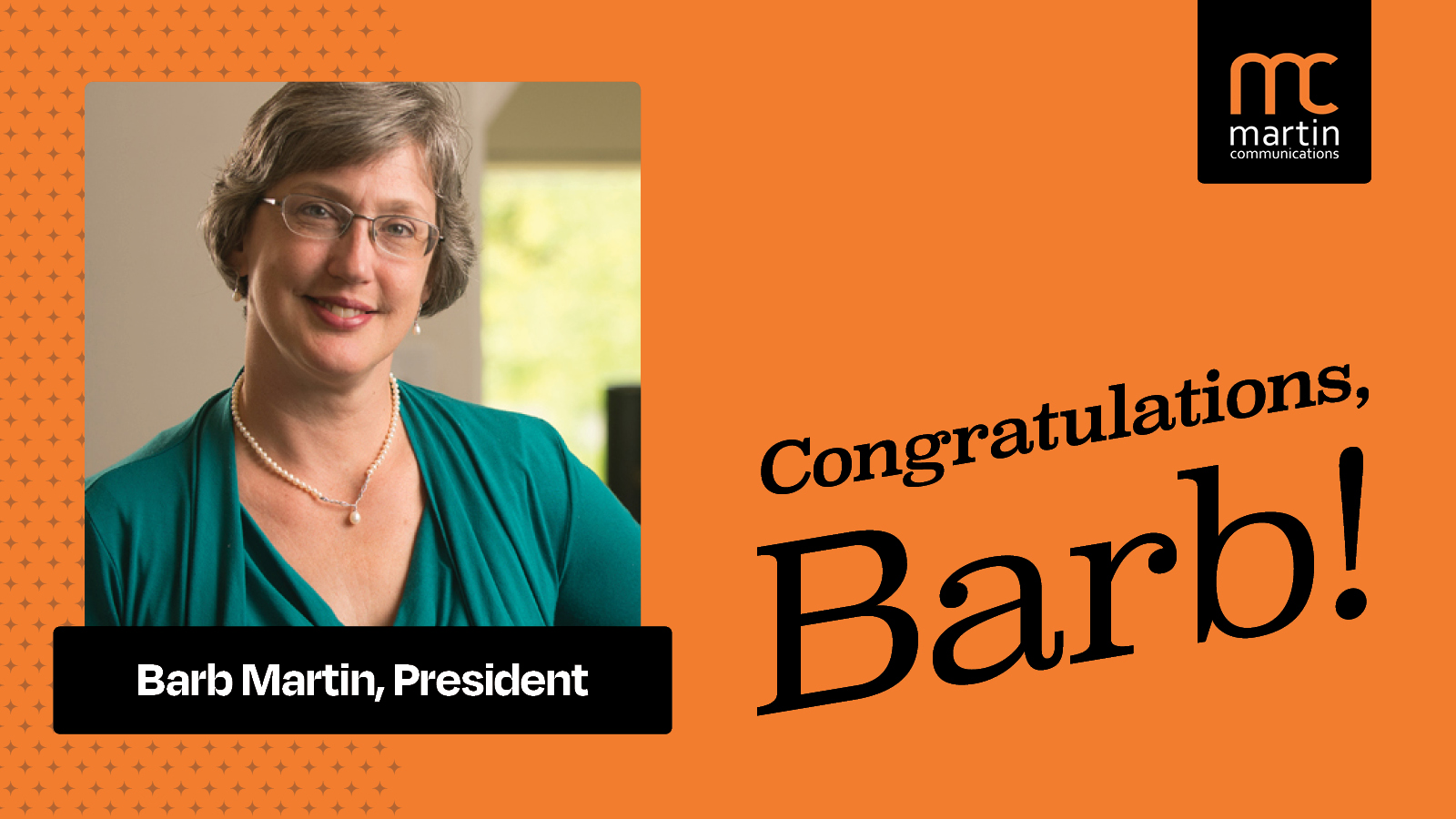
Barbara Martin named as new President of Martin Communications, Inc.

Barbara Martin named as new President of Martin Communications, Inc.Following the retirement of the company’s founder, Thomas Martin, Barbara Martin was named the firm’s president. Founded in 1993, Barb joined Martin Communications in 2001 as an administrative assistant. In subsequent years, her roles included Media Buyer, Account Manager, Account Executive, and in 2012, she was named Vice President.

“I’m looking forward to the opportunity to lead our strong team and continue the tradition of excellent, value-based, and creative marketing solutions for our clients,” said the new President.

With this leadership change, Martin Communications is now a woman-owned, woman-led business. Martin Communications, Inc. is a full-service advertising agency with a staff of 11, preparing media plans and developing creative content for clients primarily in service-oriented categories, specializing in clients within the healthcare and related fields in Pennsylvania and Virginia.